Larry Young was a jazz organist who worked relentlessly between 1960 and 1978, as a front man but most especially as a sideman. Larry worked for virtually everyone, from Miles Davis to Jimi Hendrix, and he took the Hammond organ into new realms, but he is mostly forgotten today. His story outlines the history of the organ in jazz, somewhat forgotten today. Once the workhorse of the live band, after the fusion wars, the organ was largely forgotten in favor of a drier and more 'traditional' sound by both the musicians and the aging audience.

The organ was useful as a replacement for an orchestra, and with the advent of electricity became smaller and more affordable. Radio used it constantly, and it was still supplying background music for television soap operas at least into the 1970s. Most commonly it could be found in churches, both white and black, and it became a staple of gospel music. From there, it was just a matter of time before it slipped into secular music.

Jazz itself in the post-war period wasn't simply a shift into bop, cool, and post-bop. There was a segregation in the jazz audience between those in bigger cites and smaller cities, and between white and black audiences. It was the Afro-American clubs where rhythm & blues and soul jazz was most popular, a precursor to soul music and later funk. They were the ones who accepted electric instruments like the organ and the amplified guitar, while the white college crowd preferred the straight-ahead sounds of Miles Davis and Dave Brubeck, artists who resisted electricity for decades.

I had the supreme pleasure of interviewing Lou Donaldson for a documentary in 2012 and he was by far the most fun interview I ever did in my three decade career as a video producer. Lou knew everybody and had done everything, within reason, but he was a truly humble guy who went out of his way to make me and my tiny crew feel at home both at the club where he sat in for a few songs (so I could get some footage of him playing, and where he insisted on paying our bill) and at his home for many hours the next day. As is typical of these events, his comments after the camera was turned off were even more interesting than when the tape was rolling.
Specifically, Lou talked extensively about the business of being a jazz musician in the 1950s and 1960s. He claimed that he wasn't the best sax player, just the best who wasn't a junkie, a gross underestimation of his talents. He played in 'ghetto clubs', so he and other players at the time developed the soul jazz genre, where he could sneak a little bebop into a dance tune, but it still had to be dance-able. And he welcomed the Hammond, since it could also replace the bass player, making the money split better for each player. Despite his 'no fusion, no confusion' catch phrase, he was fusing the blues and even early funk into his music, as can be seen in the clip below, with great assistance by Dr. Lonnie Smith.
Hammond organists, starting with Jimmy Smith and continuing with Brother Jack McDuff, Richard 'Groove' Holmes, Jimmy McGriff and many others, dominated the soul jazz genre, along with sax players like Lou Donaldson as well as electric guitarists like Kenny Burrell and Grant Green. These guys wanted to sell a lot of records records and play a lot of clubs, and some, like Lou Donaldson, really wanted to make the audiences happy, even singing the blues like Wynonie Harris. This was a groove-oriented jazz, less interested in being esoteric, more concerned with being popular.

One of the many players who circulated through Lou Donaldson's band was Larry Young, straight from playing in R & B outfits in Northern New Jersey. Larry was born in 1940, his father an organist. The organ had been around since the turn of the century and had been used extensively, such as in church services, funeral homes, and accompanying silent movies. Not the most promising instrument for the post-bop world, yet in the hands of someone with a talent like Larry Young, it became something else entirely. He took the organ straight into the rock world and into the hottest fusion music ever created, yet he gets very little credit today.

Larry's first recording date was in 1960, first accompanying Jimmy Forrest, whose 'Night Train' was one of the foundational songs in soul jazz and later covered by James Brown, himself a pretty good Hammond player, as evidenced on the CD 'Soul Pride; the Instruments 1960-1969', where you can literally hear soul jazz morph into funk. He was soon leading his own small groups on a couple of albums in 1960 and 1962 before hooking up with Blue Note Records starting with 'Into Something' in 1964. The earliest stuff was very much in the soul jazz groove, such as 'African Blues.
One of the great abilities of the organ - with the right player - was to 'comp' like no other instrument. 'Comping' is short for accompanying, where a rhythm player could keep the song moving under another soloist, shifting chord patterns or int he case of a bass player doing a walking bass line. Larry became a very in demand session player during the early 1960s, used on many sessions by Grant Green and Kenny Burrell, among many others because of his superior accompanying skills. It also helped that he was based out of the same area as Rudy Van Gelder.

In the history of audio recording, Rudy Van Gelder must hold the record for most sessions as engineer ever, more remarkable as he held a full-time job as an optometrist for the first twelve or so years. From the late 1940s through 2015, he recorded literally tens of thousands of jazz sessions, first in his parent's living room, then after his custom studio was built in 1959, in Englewood Cliffs, New Jersey. Rudy is famous for his clean and unobtrusive sound, helped by a stunning array of highly talented musicians who arrived rehearsed and ready to play. In an age when we are used to a band taking three years to release an album, nearly everything done by Van Gelder was recorded in a single day, with amazing results.

It also helped that the volume level of most jazz groups were low, but that doesn't detract from Van Gelder's skill set, which kept increasing over the decades. He was particularly adept at recording the Hammond organ, a notoriously difficult instrument to capture because of the many tones and overtones covering a dizzying spectrum of frequencies. It was easy for visiting musicians to travel over from Manhattan, and Rudy usually had at least one session a day as well as cutting his own lacquers to ensure the sound was transferred right. And Van Gelder worked nearly exclusively with Blue Note, the major soul jazz label.

The Blue Note years were Larry's high point as a leader, with the self-penned standard 'Tyrone' on 'Into Something' (hell, even I covered that song) and the album 'Unity' probably his best know work. Larry was beginning to show a profound influence of John Coltrane in his playing, a common-enough occurrence in the mid-60s, except that he was one of the only organ players in that mode. He also began to be influenced, abet in a subtle way, by the unique stylings of Sun Ra, a man who orbited the jazz world in his own peculiar constellation. Sun Ra had the ability to play what he called 'space chords', and Larry started using them in his comping.

No too many players managed to be influenced by John Coltrane and Sun Ra at the same time, but Larry Young did. At the same time, he started heading into jazz-rock fusion, showing up on Miles Davis' seminal 'Bitch's Brew' double album as well as joining the nastiest of the early fusion bands, the Tony Williams Lifetime. The Lifetime started out as a traditional jazz trio of guitar, organ and drums, but playing at the volume and intensity of Cream or Jimi Hendrix. Jack Bruce, the bass player of Cream, even joined the band in 1970 for a brief period. And somewhere in all this work, Larry found time to record with Jimi Hendrix, a few tracks which were released years after the fact. The following track is a somewhat low-fi but extremely rare live recording of the trio.
Tony William's Lifetime seemed a doom group for the beginning; their first album was recorded carelessly by a jazz engineer (not Rudy Van Gelder) who didn't care for the volume, and it sounds harsh and extra distorted. McLaughlin was using an acoustic guitar with a pickup in the hole, about the worst choice of instrument for music at that roaring intensity. The jazz community rejected it outright, along with a couple of follow ups also featuring Young, but McLaughlin hit financial paydirt with his Mahavishnu Orchestra. Before that, he did record one electric album with Larry on organ as well as Buddy Miles on drums.
Totally committed to fusion, converted to Islam and wearing a sheik's garb on stage, Larry wanted to explore the free jazz / free rock hybrid even more, but the entire music world was retreating to safer pastures. Rock was into more structured progressive and safer boogie, while jazz embraced Lou Donaldson's 'no fusion, no confusion' motto. There was a short lived band called Love Cry Want, utilizing primitive synths on both drums and guitars, that gigged around in 1972, producing what Lester Bangs called 'shronk' that was louder and scarier than anything else I ever heard, but it went nowhere.
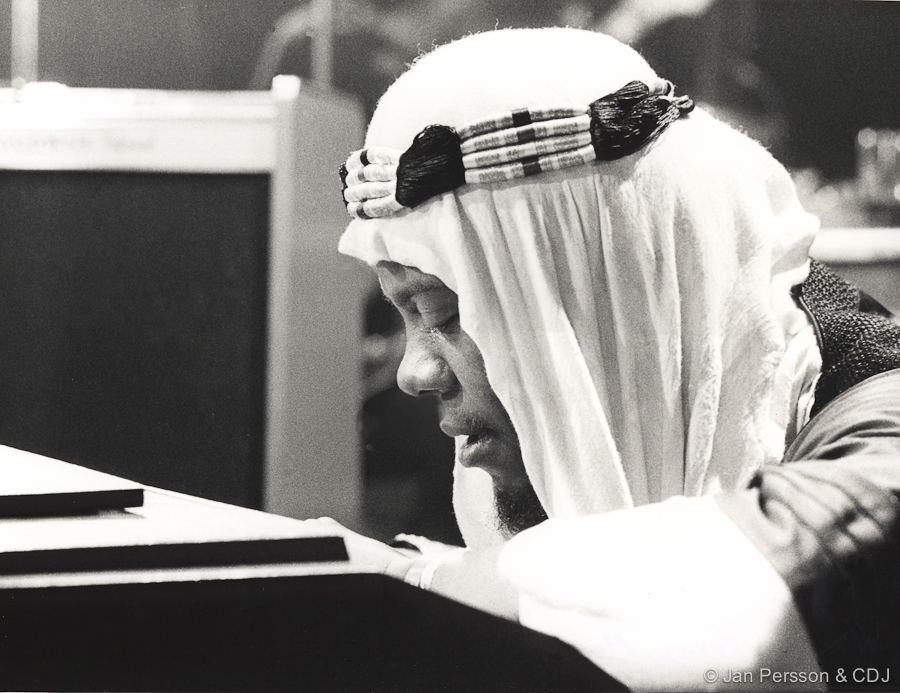
When John McLaughlin and Carlos Santana did a joint project, a fusion version of John Coltrane's 'A Love Supreme', they used Larry on the organ, both on the album and tour. It would be his last real high profile gig. He tried creating a hybrid jazz/funk outfit called Larry Young's Fuel, but two albums sold horribly. His last appearance on a record was in 1977, a duet album with keyboard player Joe Chambers; Larry's commercial stature was so low that he wasn't even mentions on the cover. He died shortly after suddenly, and the golden age of the jazz organ was officially dead.

Larry was the only guy to play with Miles, Hendrix, McLaughlin, Santana, Kenny Burrell, Grant Green, and a veritable host of other jazz greats. There was a couple of unreleased sessions, including a very good one from 1964 in Paris. While really excellent, with some of the only actual research ever done on his life, it goes back to the safer 'straight-ahead' period, where jazz purists feel comfortable. His later free funk/rock/jazz period is mostly forgotten, but Larry consistently managed to sound like no one else on the planet.
There was an inkling of interest around 2012, when the short-lived group 'Spectrum Road' was formed to celebrate the Tony Williams Lifetime. John Medeski, the only organist who could possibly try and sound like Larry, filled the keyboard, but the inclusion of Jack Bruce, right near the end of his life, skewed the project more towards him and less towards the rest of the group. At least it was something, if too little too late. Admittedly, Larry Young's later material is not for the faint of heart, it is intense and adventurist. You can't help but feel that he was punished for his ever-searching nature instead of treated like the natural treasure that he really was. That's a pity.


