H.P. Lovecraft was. without a doubt, the sorriest excuse for a professional writer in the 20th century. He had opportunities to be an editor of 'Weird Tales' but turned it down because he couldn't stand the idea of being away from his 'beloved Providence'. Yet he managed to nurture an amazing array of next generation writers, including a few giants to emerge in the post-war years, especially Robert Bloch and Fritz Leiber. When 'Weird Tales' stopped publishing his work because it became too wordy and detailed, followers typed it up and sent it to science fiction magazines, where it was eagerly purchased.

Lovecraft managed the unique trick of being simultaneously both a woeful relic of the past while stunningly ahead of his time. He had quaint and ultimately lethal ideas about being a gentleman of letters despite being the sole heir to a fortune long gone. He hated the idea of writing for money; even editing and re-writing, which he was very good at as well, was too tainted by common commerce. The great irony is that his initial reputation came from the pulps, the landscape of which was littered with hack writers and even the good ones had to hunt for new markets like bloodhounds. He was neither, and he was a misfit even among that motley crew.

'Weird Tales' was a weird magazine in more than one way. Most of the material printed in its pages was crap; the most popular author, Seabury Quinn, was a mortuary lawyer who did Sherlock Holmes knock-offs for the magazine. Wildly popular in their day, they have only been preserved because August Derleth, who eventually became the torch bearer for Lovecraft, was also a writer of Holmes knock-offs and needed another author to justify 'Mycroft & Moran' Press. The stuff, both Quinn's and Derleth's, is awful.
Mostly due to Lovecraft, as well as Clark Ashton Smith, a poet from California who needed to generate money for his parent's medical care while crafting a wonderful collection of exquisite fantasy and horror yarns, and Robert E. Howard, a hard charging Texan who wrote with amazing speed and creativity in a single-minded effort to become a professional writer, 'Weird Tales' became only one of two pulp magazines to have a reputation that extends to this current age. Young fledgling authors ate it up and started correspondences with the authors, especially Lovecraft. As a mentor, HP was excellent; he knew how to encourage someone, even re-writing a story, without profiting himself or being too harsh.

'Weird Tales' really flourished between 1928, with the publication of 'The Call of Cthulhu', until 1938, when Lovecraft and Howard were dead and Smith stopped writing largely due to late payment by the editor. It kept going for another fourteen years, which included the early flowering of Ray Bradbury among many others. But starting in 1939, when John C. Campbell took over the editing of the pulp 'Astounding Stories', and especially after the Second World War and the concluding atomic bomb, science fiction became the dominant genre in the fantastic. Most of the 'Weird Tales' writers simply shifted allegiances to better paying markets.

Lovecraft died of stomach cancer in 1937; it is quite probable that he starved himself to afford the stamps for his ridiculously prolific letter writing. It was those correspondences that formed both the bonding between authors and the nurturing of the next generation. He appointed as his literary executor Robert Barlow, a friend from Florida who was only nineteen years old at the time. Barlow was a gay child prodigy whose family had two long visits from Lovecraft down in Florida. August Derleth and Donald Wandrei had other ideas.

Both Derleth and Wandrei were working pulp authors, Derleth in particular very prolific and popular, and both lived near each other in Minnesota and Wisconsin. Derleth was a powerhouse with a tremendous work ethic, and while his efforts concerning Lovecraft were a mixed bag, without his work, Lovecraft would have soon been forgotten. The two set up a publishing firm, 'Arkham House', for the express purpose of preserving HP's fiction, and they succeeded beyond anyone's dreams.

Barlow was a casualty of this literary takeover, and the budding young fiction writer was effectively blackballed by the two from the fantasy community. In a strange twist of fate, he turned his considerable talents to Mexican anthropology, and is now considered the first great expert on Mayan culture. By sheer coincidence, when he committed suicide in 1951, one of his students at the time was a young William Burroughs, on the lam from a drug bust in New Orleans, who mentioned it in passing in a letter to Allan Ginsberg, the great American Poet. More about Barlow's strange life and career can be found in an excellent New Yorker article by Paul La Farge, 'The Complicated Friendship of H. P. Lovecraft and Robert Barlow, One of His Biggest Fans'.

Robert E. Howard, plagued by late payments and in despair over his mother's death, blew his brains out in 1936. His suicide has often been considered a contributing factor to Lovecraft's death, since despite their opposing temperaments they were great pen pals. Howard wrote prolifically and created a massive amount of work in just ten short years, including creating such memorable character as Conan the Barbarian, King Kull, and Solomon Kane. At his best, especially when writing with broad strokes, Howard propels you along through the action in a cinematic manner, although little could be considered literature. He is now firmly ensconced in popular culture alongside Lovecraft as a master of the pulps, one of the few writers who could transcend genres.

Clark Ashton Smith was the best writer of the three key 'Weird Tales' authors, although he will never become common currency in popular culture the way Lovecraft and Howard have managed. Smith achieved some fame very early in life in the San Francisco area, becoming a known poet to the likes of Ambrose Bierce and Jack London, and participating in Bohemian Grove tomfoolery with George Sterling. Being terminally shy and sickly, he quickly retreated to his aged parents farm in Auburn, California, where he crafted much poetry and a little prose. A correspondent of Lovecraft since 1922, it was HP who suggested that he start writing for 'Weird Tales'.

It is hard to recommend Smith's fantasy; it is too unique and specialized, particularly in the use of language. There is no other writer even published in the pulps who has less pulp in his style than Smith, yet he was very popular and was printed in dozens of magazines. He considered himself a poet and kept a low profile in Auburn, conducting a string of affairs with married women. I guess poetry is a good way to get laid, just not to get paid.

The irony is that all three of these writers now have posthumous careers because of 'Weird Tales' and yet they were all unlikely contributors, each with such unique talents that finding any home for their writings was a miracle. Lovecraft wrote as a complete disciple of Poe's concept of every word working to create one single effect in a story. Howard used the widest brushes possible and worked in a dizzying array of genres - westerns, spicy stories, boxing yarns - but his best stuff seemed to be historical fiction, such as 'The Sowers of the Thunder'. Smith actually got to see his work published in hard cover but lived a poverty-stricken life.

It was August Derleth who gave us the Cthulhu Mythos, not Lovecraft, just as it was L. Sprague de Camp who gave us the chronology of Conan, not Howard. The creations of these writers turned into big business in the 1960s and beyond, especially when Lancer/Ace books started putting Frank Frazetta covers on Conan. The temptation to pad things out, generating more volumes, was too tempting, and both Derleth and de Camp finished manuscripts while encouraging others to write stories. Eventually, in the 1980s, there was a backlash against this, resulting in a move back to the original manuscripts and authors.

L. Sprague de Camp did an even greater injustice by publishing the first serious biography of Lovecraft in 1977. While factually correct, it also focuses on the most salacious facts while emphasizing HP's early racist rantings. It can only be compared to contemporary biographies of Jim Morrison or Led Zeppelin, heavy on scandal, more interested in the myths than the facts. No doubt Lovecraft was racist, but he also hated himself right down to his own DNA, as seen in such stories as 'Arthur Jermyn' and 'The Shadow Over Innsmouth'. HP seemed afraid of everything, right down to the very knowledge that he craved. The secret is that he turned that universal loathing into great art.

Lovecraft married a Jewish woman and entrusted his literary estate into the hands of a man that he knew to be homosexual. HP grew as a person as he got older, and his earlier views modified over time. There is endless speculation about Lovecraft's sexual preferences, but they say more about the people making them than about the man himself. As a true Victorian, Lovecraft was taught to despise his body and his sexuality in whatever form it took. That was the engine that drove his literary output.

Howard gets backhanded compliments as a writer, if he gets any love at all. He was the consummate pulp writer, but that is seen as an insult. His sales over the decades have been enormous, but it is his imagination, as a kid from Bumfuck, Texas who absorbed every adventure story he could before the age of eighteen and then spit them back out over the next dozen years in endlessly new and imaginative ways, is the key to his remarkable talent. Of course he creates wish fulfillment fantasies; he simply does them better than any other writer in American history, on a grander scale.

Clark Ashton Smith escaped having his legacy shat upon by editors adding to his canon, perhaps the only advantage of being more obscure. It wasn't for lack of trying; by pure accident, I grew up in Bellerose Terrace on Long Island and noticed that Lin Carter, another writer and editor who specialized in pure fantasy, used the byline of Hollis, the town literally on the other side of the railroad tracks. At the tender age of fourteen I took my six foot tall bulk over to his house and knocked on the door. He answered, a small, slim man with a goatee, and welcomed me inside. We chatted a few times over the next eighteen months, and he tried to guide my taste in literature.

I had probably read the first book of the 'Lord of the Rings' trilogy and some of the Conan Lancer editions; naturally, I thought that I was an expert on all thing fantasy. Lin schooled me quickly but gently, and since he was in the middle of editing the Ballantine Adult Fantasy series, as well as the author of the first scholarly book about Tolkien, information flowed quicker than I could absorb. There were bits of gossip that I didn't quite understand at the time, such as de Camp's general dislike of sword & sorcery in general and Howard in particular, but Lin said it was simply a paycheck. Mostly it was long discussions about the history of fantasy, connecting the myths and legends of the past to the literature of today.

Lin Carter also introduced me to the work of Clark Ashton Smith, recommending his writing to me in the strongest terms. A few volumes were appearing in the Ballantine Adult Fantasy series; I bought them and devoured them, absolutely delighted with the contents. Carter had a great knowledge of the classics, and was very good at finding references or echoes of classical themes in more modern work. As an editor he was without peer for his time, and single-handedly brought some type of scholarship not only to what he termed 'adult fantasy' but to the pulps as well. It didn't really matter that his fiction was second rate and derivative; his true worth lay elsewhere.

Not everything Lin recommended stuck, such as James Branch Cabell, whom I still find boring, but I did appreciate Lord Dunsany, E.R. Eddison, Mervyn Peake, and William Hope Hodgson. He also had a pretty complete collection of 'Weird Tales' and would talk about the more obscure writers published there. Perhaps the best thing he ever did was connect my last name, Nestor, a common Irish surname from Galway, to 'The Iliad' and 'The Odyssey'. I still use that line of bullshit to this day when someone tries to use the 'who's your daddy' argument with me, very common to this day down south. You should see the look on on their face when I trace my lineage back well over three thousand years! Thank you eternally, Lin!
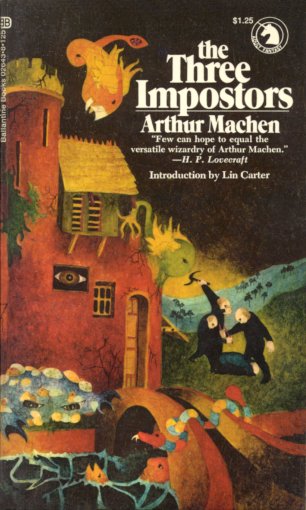
Carter did try, unsuccessfully, to duplicate the success of Howard and Lovecraft with Clark Ashton Smith, writing new stories set in the imaginary universes of his favorite writer. He also wrote pastiches of Howard, Lovecraft and Dunsany, and much of his fiction is very much in the style of Edgar Rice Burroughs. He was unfailingly polite and patient with me; we never talked for less than hour and he only hustled me out the door once because of a meeting with a publisher. I lost touch with him in late 1972 when my family moved to York, PA, but I will impulsively buy any edition of a Ballantine Adult Fantasy that I find in a used book store to this day.

Carter moved on the the 'Flashing Swords' series, focusing more on living writers, although some of the Ballantine Adult fantasy series had done that as well. He always seemed to realize that there was a limited window to present these stories by other authors to the public, and his choices were always superb. People complain that he included his own stories too often, but it is obvious that he never profited in any substantial way from his editorial work. It was purely a labor of love. Every time you go into a bookstore an d see a massive three volume (or more) modern fantasy series, or watch some CGI fantasy spectacular, you have Lin Carter and his hard work from fifty years ago to thank.


